Why We Hate Politics (Polity Short Introductions) by Colin Hay
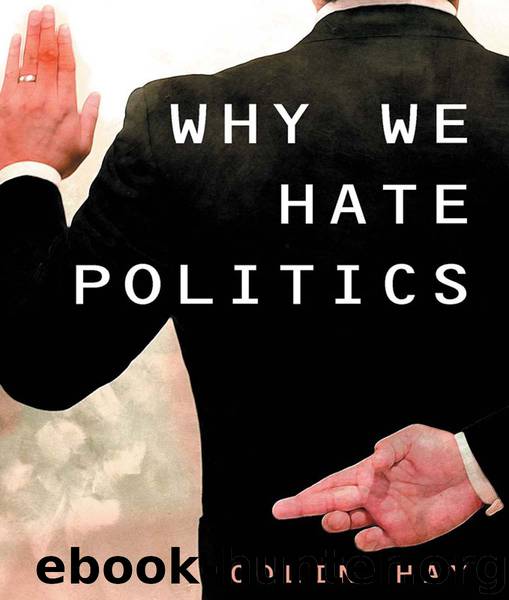
Author:Colin Hay
Language: eng
Format: mobi, epub
Publisher: Wiley
Published: 2013-05-06T04:30:00+00:00
Public choice theory
Public choice theory is a variant of rational choice theory (for useful introductions, see Dunleavy 1991; Hindmoor 2006; Mueller 2003). It developed, initially, in the US in the 1960s as a response to the then influential tradition of welfare economics. The latter had sought, in effect, to derive the need for a state which might intervene within and regulate the market, correcting its natural tendency to failure. Such a state would, in particular, be charged with correcting the innate tendency of the market to under-supply public or collective goods – such as security, health and welfare more generally.2 Countering this, public choice theorists sought to develop, in Nobel laureate James Buchanen’s terms, a ‘science of political failure’ (1988: 3) in place of welfare economics’ science of market failure. As Andrew Hindmoor explains, ‘whilst welfare economists had shown how and why the market might sometimes fail they had simply asserted rather than demonstrated the ability and willingness of the state to correct those failures’ (2006: 85). At best they had demonstrated the need for a function to be performed (that of market regulation and the correction of market failure), not the capacity of the state to perform that function. Indeed, in challenging the conventional fiction of the perfect market that had tended to dominate professional economics, they had constructed a similarly idealized depiction of the state. A rather more sanguine and realistic view of the similarly imperfect state, it was argued, would lead to a rather safer set of inferences about the need for state intervention. Public choice theory sought to provide that assessment. From the start, then, public choice theory was not favourably predisposed towards the state and, in its preference for the market over the state, had something of a natural affinity with neoliberalism (on which see Dunleavy and O’Leary 1987: 72–135; D. S. King 1987; Self 1993).
Public choice theory approaches the question of state failure using fairly standard rational choice theoretical techniques and assumptions. In short, it models political behaviour on the simplifying premise that political actors are instrumental, self-serving and efficient in maximizing those benefits (net of cost) that they seek to achieve (their ‘utility function’). Its aim is the construction of a series of stylized (often, algebraic) models of political conduct. What make this possible is the assumption that political actors and public officials are rational and behave as if they engage in a cost–benefit analysis of each and every choice available to them before plumping for the option most likely to maximize their given ‘utility function’ (generally, an expression of their material self-interest). 3 They behave rationally, maximizing personal utility net of cost whilst giving little or no consideration to the consequences, for others, of their behaviour. 4
The product of all of this is a series of stylized models (many algebraic in form) which explore logically the consequences of assuming the worst of elected officials on the one hand and ‘public servants’ on the other.5 In the sections that follow we turn in
Download
Why We Hate Politics (Polity Short Introductions) by Colin Hay.epub
This site does not store any files on its server. We only index and link to content provided by other sites. Please contact the content providers to delete copyright contents if any and email us, we'll remove relevant links or contents immediately.
| Anthropology | Archaeology |
| Philosophy | Politics & Government |
| Social Sciences | Sociology |
| Women's Studies |
The Secret History by Donna Tartt(19476)
The Social Justice Warrior Handbook by Lisa De Pasquale(12297)
Thirteen Reasons Why by Jay Asher(9128)
This Is How You Lose Her by Junot Diaz(7060)
Weapons of Math Destruction by Cathy O'Neil(6476)
Zero to One by Peter Thiel(5953)
Beartown by Fredrik Backman(5949)
The Myth of the Strong Leader by Archie Brown(5631)
The Fire Next Time by James Baldwin(5592)
How Democracies Die by Steven Levitsky & Daniel Ziblatt(5333)
Promise Me, Dad by Joe Biden(5237)
Stone's Rules by Roger Stone(5196)
A Higher Loyalty: Truth, Lies, and Leadership by James Comey(5091)
100 Deadly Skills by Clint Emerson(5031)
Rise and Kill First by Ronen Bergman(4907)
Secrecy World by Jake Bernstein(4892)
The David Icke Guide to the Global Conspiracy (and how to end it) by David Icke(4854)
The Doomsday Machine by Daniel Ellsberg(4627)
The Farm by Tom Rob Smith(4614)
